
There are are a lot of amazing things to see around the world from ancient architecture to massive mountains. However, few things compare to the simplistic splendor of a waterfall.
Fortunately, the world has given us no shortage of waterfalls and if that wasn’t enough people got to peopling and made some amazing waterfalls of their own. With so many amazing waterfalls to choose from it is hard to say which are the top 10 waterfalls in the world.
But we’re going to do it anyway
Here is our list of the 10 most amazing waterfalls from around the world!
#10 – Most Beautiful Waterfall – Iguazu Falls, Brazil
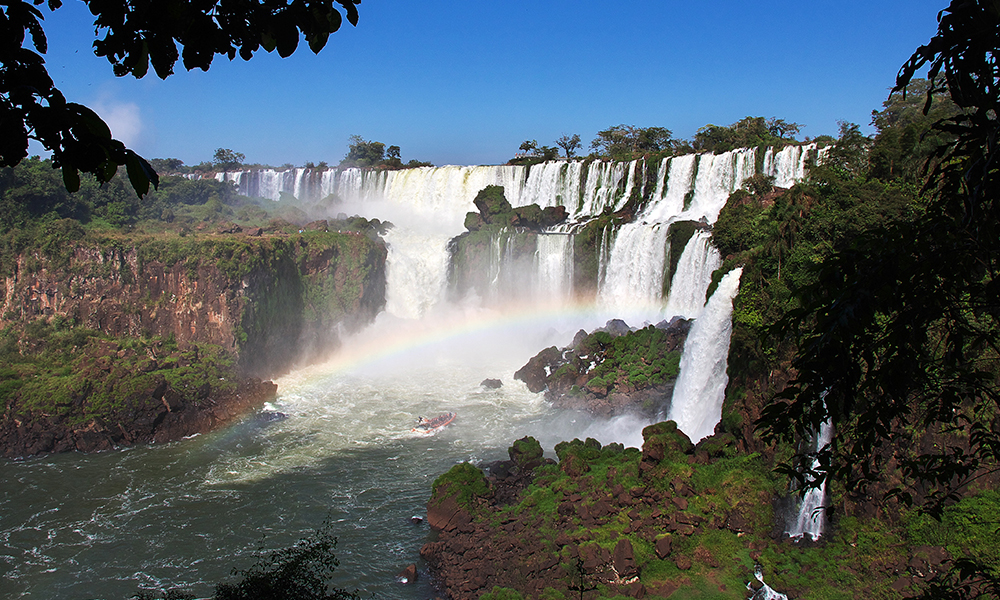
With so many stunning waterfalls, it’s hard to consider it a beauty contest. And, while this is definitely a subjective opinion, there is one waterfall that is a stand-out winner when it comes to aesthetics: Iguazu Falls. With an incredible 275 individual drops, Iguazu Falls is an other-worldly scene that can’t be beat.
Resting along the border of Brazil and Argentina in the state of Paraná, Iguazu Falls is technically owned by two UNESCO World Heritage Sites: Iguazú National Park in Argentina and Iguaçu National Park in Brazil. At 1.7 miles wide and 200 ft to 269 ft, Iguazu Falls isn’t just beautiful, it’s huge, too.
Most of the water rushing over Iguazu Falls goes down Devil’s Throat, a chasm that’s about 60 ft high, 93 ft wide, and 434 ft long, with a distinctive U-shape. Within the Iguazu River that feeds the falls, there are several islands. The river itself is divided into the upper and lower portions, both of which are steeped in local myth and legend.
The name Iguazu originates from the Tupi or Guarani languages and means “Big Water.” Despite being well known by local indigenous people, Iguazu Falls was first recorded in the Western world in 1541 by European explorer and Spanish conquistador Álvar Núñez Cabez de Vaca. In recent years, Iguazu Falls has been an extra in several big-budget movies, including Happy Together (1997), Mr. Magoo (1997), Miami Vice (2006), and Indiana Jones and the Kingdom of the Crystal Skull (2008).
If you plan a trip to Iguazu Falls, schedule it during the spring or fall months. During the summer, the intense heat and humidity can create uncomfortably muggy conditions, while the winter months lead to a drop in the water flow.
Do you think that there is a more beautiful waterfall than Iguazu Falls, let us know in the comments.
#9 – Largest Single Drop By Volume – Kaietur Falls, Guyana
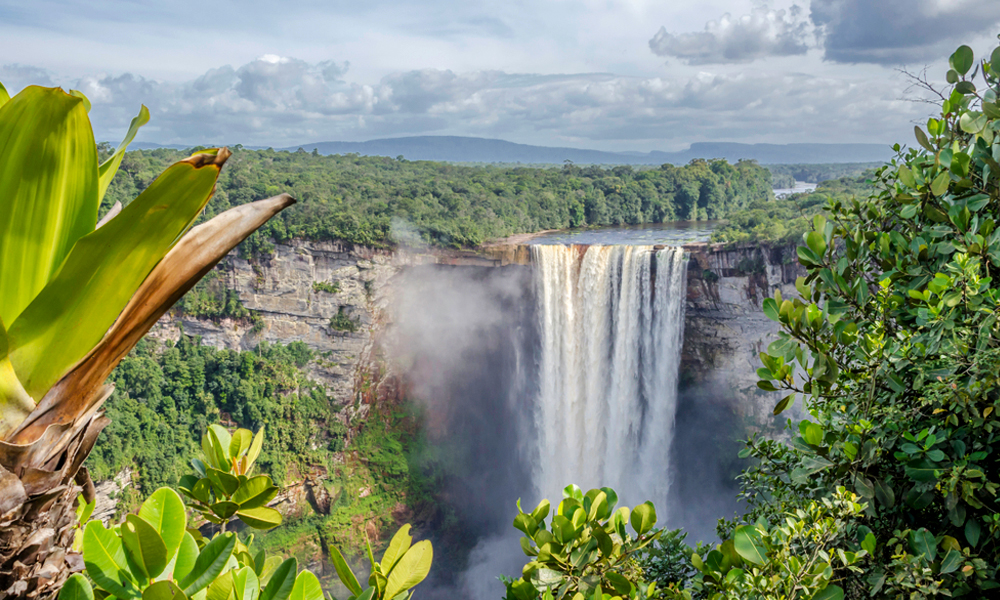 Found on the Potaro River in Kaietur National Park in the Guyana region of the Amazon rainforest, you’ll discover Kaietur Falls. At a staggering 741 ft tall and with an average flow rate of 23,400 ft³ per second, Kaietur Falls has the largest single drop by volume.
Aside from its power, Kaietur Falls is known for having some incredible surroundings. Snuggly positioned in the Amazon rainforest, deep green foliage and a colorful array of animals call the area home. You won’t be able to get there by car or even by foot. Instead, to visit Kaietur Falls, you’ll have to charter a plane. Luckily, there are many local outfitters that are ready and willing to take tourists on a bird’s-eye view of the Kaietur Falls. If you plan a trip, the best time is during the summer monsoons, typically April to September.
#8 – Coldest (and Most Difficult to Pronounce) Waterfall – Aldeyjarfoss Waterfall, Northern Iceland
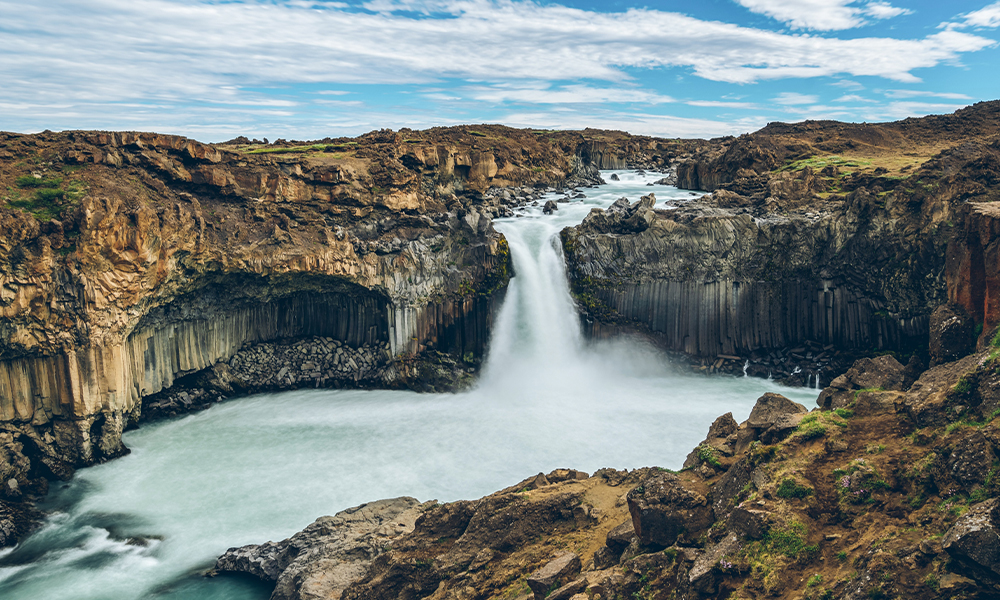 Objectively the coldest waterfall – and subjectively the most difficult to say – is Aldeyjarfoss Waterfall. A feature of the Skjálfanda Fljót River in Northern Iceland, Aldeyjarfoss Waterfall has a drop of almost 66 ft, set among the basalt columns of the surrounding rockface. With an array of colors – greys, yellows, black, brown, and even orange – there’s no denying Aldeyjarfoss Waterfall, though hard to pronounce, is easy on the eyes.
One perk of visiting Aldeyjarfoss Waterfall is its lack of tourism. It’s not heavily visited like some other waterfalls, meaning the natural beauty still shines brightly. Sitting about 25 miles from the Bárðardalshraun Lava Field that gives lasting proof of an eruption 9,000 years ago, Aldeyjarfoss will offer more than stunning views. There’s also some great hiking in the surrounding area.
When visiting Aldeyjarfoss Waterfall, you have a couple of options: the north bank and the south bank. The north bank offers some of the most gorgeous photos of the waterfall because you can see the entire rounded basin. The south bank is the official site of the falls and won’t disappoint when it comes to scenery. Aldeyjarfoss Waterfall is so picturesque, the award-winning icelandic film Hrútar (2015) was filmed nearby.
#7 – Biggest Man-Made Waterfall – Cascata Pelle Marmore, Italy
 Found in Umbria, Italy, Cascata Pelle Marmore, also known as Marmore Falls, is the largest man-made waterfall and one with a complicated and interesting history. At a height of 541 ft, it’s clear it was no small feat for the Ancient Romans who built it.
Marmore Falls has three sections, with the tallest being the top section at 272 ft. Located a little more than 4.5 miles from Terni in the Umbria Region of Italy, Marmore Falls is fed by the River Velino. After it flows through Piediluco Lake near the town of Marmore, the river continues to the man-made falls.
In ancient times it was first thought of, the river fed a wetland area in the Rieti Valley. The people at the time believed this to be a source of Malaria. To address the concerns, Roman Consul Manius Curius Dentatus ordered the construction of a new canal to restore the original flow. This became known as the Gregorian Trench or Rieti Trench.
Later, in 1545, a new canal was ordered by Pope Paul III, which led to a renaming: the Pauline Trench. The plan was to expand the Curian Trench and build a regulating valve to give the people more control over the flow of water. By the time the canal was finished, it inherited a new name for the pope who inaugurated it, Pope Clement VIII, who called it the Clementine Trench.
Fast forward to 1787 and Pope Pius VI wanted a face-lift for the canal. He ordered architect Andrea Vici to modify the leaps between the falls, giving it the look we see today. This was more than a simple aesthetic choice – it also resolved a frequent flooding issue.
Today, the water in the canals above the falls is usually diverted to a hydroelectric power plant. This has led to a heavily reduced flow to the falls. Despite the diversion, the falls are still turned on for tourists. If you visit, listen for the alarm that sounds. You’ll see the gates open and the water rushing forth. Typically the falls are turned on between 12:00 to 1:00 and 4:00 to 5:00 daily.
There’s an observatory next to the falls where you can enjoy a front-row seat to the water show, even likely being drenched. Another observatory is stationed near the top of the falls which offers stunning views and the chance to stay dry.
#6 – Most Water Flow – Inga Falls, Democratic Republic of Congo
 Positioned about 21 miles from Matadi in the Democratic Republic of Cong, where the Congo River drops 315 ft over the course of nine miles, we find Inga Falls. More than just a standalone site, Inga Falls is part of a family of rapids in the Lower Congo River. It holds the title of the waterfall with the most water flow, thanks to its median flow of 1.5 million ft³ per second.
Inga Falls is also the site of two massive hydroelectric dams, Inga I and Inga II. Additionally, two more hydroelectric dams are planned for the area, known as Inga III and Grand Inga Dam. These would be the largest in the world in terms of power production. It seems that Inga Falls has more titles to take home soon.
#5 – Biggest Waterfall – Victoria Falls, Zambia & Zimbabwe
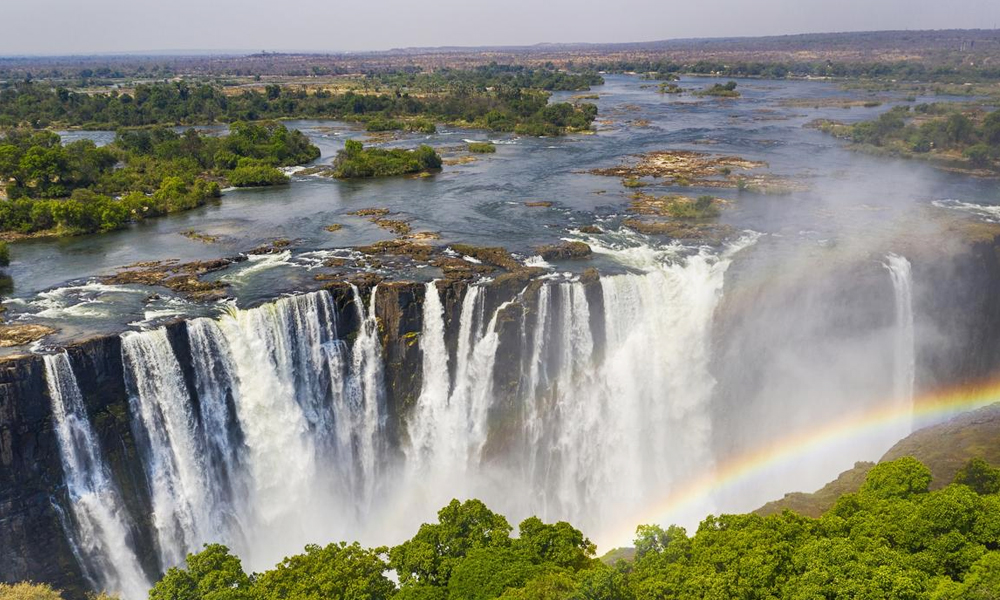 Overshadowing Niagara Falls and Iguacu Falls, with a width of about 5575 ft, we have the biggest waterfall: Victoria Falls. In reality, Victoria Falls comprises five different falls, four in Zimbabwe – Devil’s Cataract, Main Falls, RAinbow Falls, and Horseshoe Falls – and one in Zambia – Eastern Cataract.
Fed by the Zambezi River, Victoria Falls reaches a height of 233 ft to 360 ft, depending on which of the five falls you’re looking at:
- Devil’s Cataract: At nearly 230 ft high, Devil’s Cataract is named for the adjacent island in the river. There, local tribes would perform sacrificial ceremonies. Early missionaries in the area referred to the practices as “devilish,” giving the fall its name.
- Main Falls: Coming in at 305 ft and stretching wide across the area of Victoria Falls, Main Falls is the largest of the five falls that make up Victoria Falls, with a peak flow rate of almost 2.3 million ft³ per minute. It also has the most majestic view. It’s incredible height leads to the water turning to mist before it hits the bottom of the rockface.
- Horseshoe Falls: Coming in at about 311 ft high, Horseshoe Falls gets its name from the distinctive horseshoe shape it forms. Sadly, this is the section with the lowest volume of water and is the first to dry up, typically between October and November.
- Rainbow Falls: The highest point of Victoria Falls, Rainbow Falls reaches a height of nearly 360 ft. It gets its name for the rainbow that can frequently be seen on clear days. Even more magical, you can sometimes catch a lunar rainbow in the waterfall when there’s a full moon.
- Eastern Cataract: The only one of the five parts of Victoria Falls that lies entirely in Zambia, Eastern Cataract stretches to a height of more than 330 ft. If viewed from the Zimbabwe side, you’ll get an incredible view, so grab your camera.
#4 – Tallest Indoor Waterfall – Jewel Rain Vortex, Changi Airport, Singapore
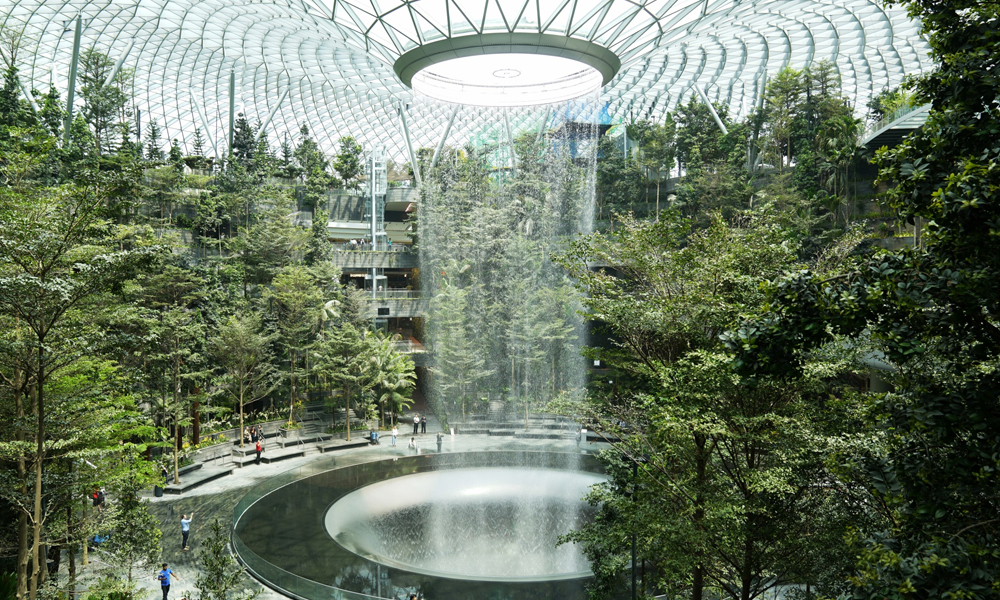 While most think of waterfalls as outdoor, natural features of a landscape, architectural innovations have brought these gorgeous features indoors, at least at the Changi Airport in Singapore. Engineers by Los Angeles-based design firm WET, the Jewel Rain Vortex isn’t just an engineering feat, it’s also an architectural art piece.
When it rains, the precipitation is collected and harvested, then recirculated to fall from the ceiling of the seven-story structure. Most unique to this waterfall is its shape: it’s circular. At night, this shape is used to feature a 360° projected light and sound show.
Speaking of the impressive feature, WET design director, Peter Kopik explained how the waterfall and the building connect: “It’s a continuation of the building. It’s like the roof is pouring in and the building is getting completed in a liquid form.” There is no doubt it’s a marvel of modern architecture, but also a beautiful reminder of the delicate beauty and colossal power of waterfalls everywhere.
#3 – Widest Waterfall – Khone Falls, Laos
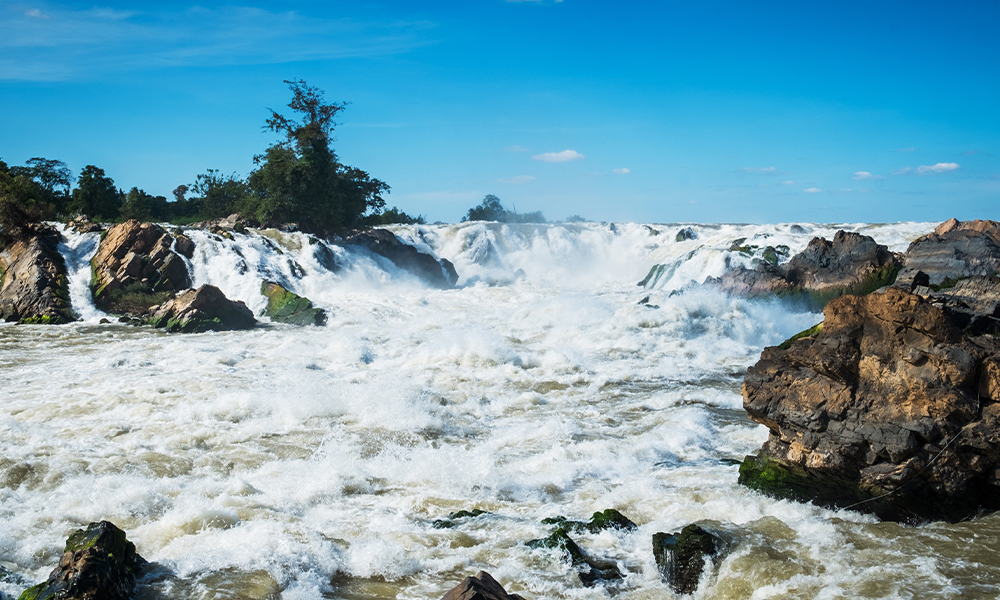 Known also as Khone Phapheng Falls and by the French name, Chutes de Khone, Khone Falls is the largest waterfall in Southeast Asia in terms of volume. It also makes up part of the border between Laos and Cambodia, making it a barrier between the Upper and Lower Mekong Rivers.
The rapids and falls that make up Khone Falls are completely impassable by boat. It’s one of the main reasons the Mekong River can’t be fully navigated by boat, especially if you’re taking a route from China to Cambodia to Vietnam and finally to the South China Sea.
The river that feeds Khone Falls, the Mekong River, holds thousands of tiny islands, all tucked within the rapids. The area is actually known as Si Phan Don or The 4000 Islands. Surprisingly, many of these islands are inhabited and house settlements. Because of the treacherous rapids, navigating the Mekong River by ship has been an issue for sailors, traders, and travelers for generations. There is simply no good route through the rapids.
Khone Falls takes the title of Widest Waterfall because it spans 35,376 ft. Though petite when compared to some of the other waterfalls on this list – reaching a mere 230 ft with a maximum single drop of less than 70 ft, it also has the largest flow rate in the world. The average flow rate is 38,090 ft³ per second, with a record flow rate of 160,761 ft³ per second.
The rapids that make up the Mekong River stretch for six miles and though they are tricky for sailors, they pass through the home of many types of rare flora and fauna, as well as the inhabited islands. The largest of these is Don Khong, where former Laos President, Khamtai Siphandon, has a residence.
The falls were carved out of the earth by the Mekong River as it cut through hard basalt. It’s believed this could be an old fault line on the Sunda tectonic plate. Regardless of its origins, Khone Falls, today is a tapestry of natural wonders that only Southeast Asia can provide.
#2 – Highest Waterfall – Angel Falls, Venezuela
 Also known as the Salto Churún Merú and nestled in the Guiana Highlands in the state of Bolívar in Venezuela, we find the world’s highest waterfall and one known for incredible beauty: Angel Falls. Located in southeastern Venezuela on the Churún river about 160 miles southwest of the Ciudad Bolívar, this diamond of South America stands tall and proud.
With a drop of about 3,212 ft and 500 ft wide at its base, Angel Falls is a site to behold. It flows from the Auyán-Tepuí plateau, also called Devil’s Mountain. It rushes over the edge of the plateau at such speeds that it hardly makes contact with the rock face. Because of its home in the Canaima National Park, it sits in a backdrop of dense, emerald jungles.
While it was likely known to local indigenous people, it was first recorded after being spotted by outsiders in the 1930s. Named for James Angel, an American explorer, and adventurer who crash-landed his plane on a nearby mesa, Angel Falls is like a hidden gem in one of the deepest, most secluded areas of Venezuela.
In 2009, the Venezuelan President, Hugo Chavez, declared that Angel Falls should be referred to by the name it was given by the area’s original inhabitants: Kerepakupai Merú. Whatever it’s called, Angel Falls is a must-see for any world traveler.
#1 – The Tallest Waterfall – Denmark Strait
 When you think of waterfalls, you likely have an image of water rushing speedily off the top of a cliff or cascading gently down a rock face. But the largest waterfall in the world is found in an unlikely location: underwater.
The Denmark Strait separates Iceland and Greenland. Below the surface, immense cataracts begin, but you’ll never see them in person. At 2,000 ft below the surface, they are far from the prying eyes of humans. But one of these cataracts drops an incredible 10,000 ft, or approximately two miles. Here we find the world’s largest waterfall.
This underwater waterfall is possible through the natural rules of science. Because cold water is more dense than warm water, it sinks. In the Denmark Strait, the icy water flows south from the Nordic seas. Along the way, it collides with warm water at these gargantuan cataracts. The chilled water sinks rapidly, flowing over a huge drop to the ocean floor below.
It’s estimated this behemoth flows at about 123 million ft³ per second. Despite its incredible size and magnitude, it’s kept hidden below the mysterious surface of the Denmark Strait, only observable using scientific instruments. Perhaps one day it will be viewed for the first time by human eyes.
______________
Are you ready to go see these amazing waterfalls? Like we said in the beginning, it’s hard to narrow down a list of the 10 most amazing waterfalls so let us know down in the comment what your favorite waterfall is. Did it make it onto this list? Maybe we will need to make a part 2.